Jackson Thorne
I Spent 4 Hours Trying To Hurt An Athlete. He's 9 Months Out of Surgery.
A case study on an athlete 9 months post-ankle surgery, pushed through hours of progressive loading to find his real limits. Instead of pain, he hit a lifetime jump-power PR.
I spent over 4 hours trying to hurt an athlete 9 months post-ankle surgery. Instead, all that happened was that he hit a lifetime jump power PR.
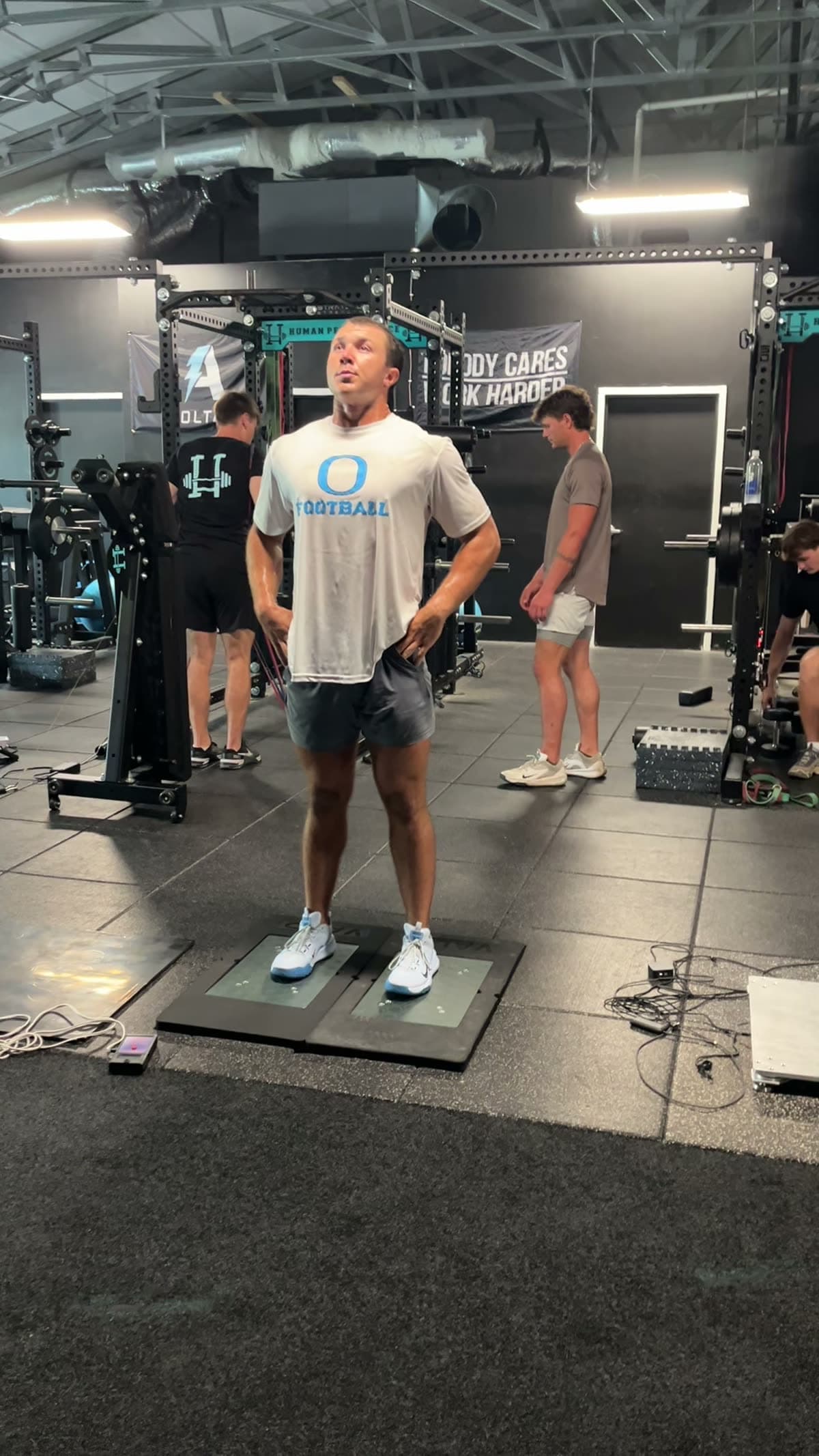 Athlete training session
I made him do 20 minutes of direct current lower half flush, 8 lower body ForceFrame tests 3 times each, 6 different 5 minute isometrics then 1 hour of weighted pogo hops (up to 70lbs on each side of Pit Shark), then 20 curved sprints, and 10 5-10-5s.
The goal was to hurt him.
He's an elite HS football player who's unable to recover between sessions, which shows a severe workload limitation. So we need to progress volume to the limit of tolerance (the instance at which any pain first appears), to show compensations have disappeared, and we have isolated the surgically repaired ankle.
Once pain appears, the plan was to use the Volta X device to send a high-frequency (500hz) and high-amplitude (hopefully 100mA) signal into areas of high electrical resistance. This allows us to override neurological pain signaling. This teaches the brain that the body is safe, allowing it to trust the months of prior rehab that prepared the athlete to meet and exceed the physical demands of his sport.
After introducing all pain, we remove all of it in under 20 minutes. And since we have trained past the current workload tolerance, compensations entirely disappear under fatigue. Surpassing compensations allows us to work out even more using specific exercises. These teach the brain how to load and unload the ankle with a preferred strategy that is more symmetrical and reduces the risk of future injury.
The Vald ForceFrame allows us to isolate every single joint action combination we want to analyze (hip: flexion, extension, adduction, abduction, knee: flexion, extension, ankle: plantar flexion, dorsi flexion, eversion, inversion) with the maximal strength and rate of force development, along with asymmetries from side to side.
Using this test, we knew that the right ankle was surgically repaired, but solely tasked to handle such a significant workload. I found major red flags in numerous tests, which painted the perfect picture of his situation. His right glutes and hamstrings were significantly weaker, while the left quad and tibialis anterior were weaker than the right. This pairs perfectly together and was expected, but having the ForceFrame to corroborate is a necessity.
The 6 isometrics I selected for the athlete were designed around providing neural inputs that can drive the outputs required to healthily continue dominating his sport.
After using isometrics to provide balance, we challenged him with 10lb pogo hops that elicited pain in the previous week. This time, there was no pain. The plan was to continue these until pain showed up.
After 50 minutes of 30 seconds on and 30 seconds off, we were unable to recreate his pain. So we decided to continuously increase the weight up to 70lbs on each side. Still nothing.
After asking the athlete what else bothers him, the first thing he mentioned was curved sprinting. So we added curved sprints. And we continued hitting 20 total sprints using the OVR sprint gates to push output. Still nothing.
Then the athlete mentioned a slower 5-10-5 with discomfort at a recent camp he attended. So I made him do these with the 1080 Motion to assist the 10-yard sprint, which increases the demands on the ankle in change of direction with 10KG pulling him.
After running 10 of these, I was still unable to get any instance of pain. The athlete was watching multiple other athletes hit all-time PRs on their CMJs, and being the absolute psycho that he is, he, too, wanted to jump. I told him I'd give him 1 jump for everything I made him do, and expected him to be down by 1,000W or more from his all-time bests. His jump was 6,800 Watts, only 300 off his PR. I asked if he had any more in the tank. 3 jumps later, he had eclipsed 7,200W and set an all-time personal record by just over 50W.
At this point, I sent him to the red light therapy room and made him do a full-body direct current "reset". He tried asking me if he should do anything else at home. After laughing at how psychotic he is, I told him 6,000 calories, grounding, and a walk in the ocean.
The next day, he came back in with still 0 pain in the ankle or up the lateral shin as he had been feeling as of late.
After spending 4 hours trying to "beat him up", he won. Although I didn't achieve my "goal", this is an incredible sign for his upcoming senior season. After 4 hours of trying to push the ankle to its limit, I was unable to. This is what good rehab looks like. Good rehab prepares the athlete for not only the intensity of their sport, but also the frequency and volume. If an athlete can match their pre-surgery sprint velocity but only tested 2-3 times, the practitioner has no idea if this athlete is truly ready for the demands of their sport. For this athlete, who is practicing for hours on end each day, 2 PT visits per week are inherently insufficient for any return to sport clearance.
If they can run 1 sprint that's fast enough to be cleared, should they really be cleared for a game where they may sprint over 100 times across 4+ hours?